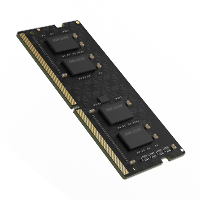
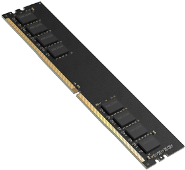
Dual 32-bit Sub-channels: From "Single-Lane Road" to "Dual-Lane Highway"
DDR5 memory introduces the Dual 32-bit Sub-channel Architecture for the first time, splitting the traditional 64-bit data bandwidth into two independent 32-bit channels (i.e., "sub-channels"). This design is akin to upgrading a single-lane highway to a dual-lane one—data streams that once traveled in a single direction can now be transmitted simultaneously through two sub-channels, significantly improving overall efficiency.
Specifically, while the total bandwidth of DDR5 memory modules remains 64-bit, the dual-subchannel division allows the memory controller to manage data requests more efficiently. For example, in multitasking or high-concurrency scenarios, the two sub-channels can handle separate read/write operations, reducing wait times and lowering latency while boosting bandwidth utilization.
Technical Details: How Dual Channels Enhance Performance
· Improved Data Access Efficiency
DDR4 memory uses a single 64-bit channel, which can lead to "queueing" when multiple data requests occur simultaneously, increasing latency. In contrast, DDR5’s dual 32-bit sub-channels enable the memory controller to process two independent 32-bit requests concurrently, effectively splitting a single data transfer into parallel operations, significantly enhancing throughput.
· Reduced Latency Bottlenecks
In traditional single-channel architectures, the memory controller must process requests sequentially. Dual-channel designs allow "time-sharing" of the two sub-channels, shortening data wait times. For instance, in gaming scenarios, dual-channel architecture can accelerate texture and scene data loading, reducing stuttering.
· Compatibility and Scalability
DDR5’s dual-subchannel design also supports flexible configurations. For example, server-grade RDIMM memory can integrate 8-bit ECC correction in each sub-channel, further enhancing data reliability. Additionally, the dual-channel architecture lays the foundation for future high-density memory expansion (e.g., Die capacity jumping from 16Gb to 64Gb).
Practical Applications: Full-Spectrum Upgrades from Consumer to Enterprise
· Consumer-Level Scenarios
· Gaming and Content Creation: The dual-channel architecture significantly boosts memory bandwidth, accelerating game loading speeds and enabling smoother multitasking in video editing and 3D rendering.
· Overclocking Potential: Combined with lower operating voltage (1.1V), the dual-channel design provides greater headroom for DDR5 memory overclocking. For example, some DDR5 modules can stably operate above 6000MHz, even exceeding 8000MHz.
· Enterprise-Level Scenarios
· Servers and AI Computing: The dual-channel architecture, paired with ECC error-correction mechanisms, ensures stability in large-scale data processing. For instance, Micron’s 9200MT/s RDIMM modules offer ultra-high bandwidth support for AI training and data centers.
· Energy Efficiency Optimization: The dual-channel design reduces signal interference and power consumption, making it ideal for servers requiring prolonged high-load operation.
Future Outlook: Evolution of Dual-Channel Architecture
The dual 32-bit sub-channel design of DDR5 not only addresses performance bottlenecks in DDR4 but also provides a reference for next-generation memory technologies (e.g., HBM4 stacking architectures). With the mass production of domestic DDR5 chips (e.g., breakthroughs by Yangtze Memory Technologies), the cost of dual-channel technology will decrease further, driving its adoption in broader fields.
Conclusion
The dual 32-bit sub-channel architecture in DDR5 marks a pivotal shift in memory technology—from a focus on "pure frequency pursuit" to "system-level optimization." By parallelizing data access, reducing latency, and enhancing bandwidth utilization, it injects new performance vitality into both consumer and enterprise scenarios. As the technology matures and applications deepen, DDR5 will continue to lead the revolution in computer hardware.
For more details on DDR5 technology or product information, please visit our official website or contact our technical team!